How to Fertilize Houseplants: When, How Much, and What to Use
4 min read
Fertilizer is one of the most misunderstood parts of plant care. It is often treated as medicine, something to give a sick plant, when it is better thought of as food for a healthy, growing one. Used well, it supports strong growth. Used badly, it burns roots and leaves. Here is a simple, practical approach.
What fertilizer does
Plants make their own sugars from light through photosynthesis. Fertilizer does not give them energy. It supplies mineral nutrients that they cannot make, which they take up through their roots. The main ones are nitrogen, phosphorus, and potassium, along with smaller amounts of calcium, magnesium, iron, and others.
Potting mix contains some nutrients, but a plant uses them up over time, and watering washes some out. That is why feeding becomes useful after a few months.
Reading the numbers
Fertilizer labels show three numbers, the N-P-K ratio, such as 10-10-10 or 3-1-2.
- N (nitrogen) supports leafy, green growth.
- P (phosphorus) supports roots and flowers.
- K (potassium) supports overall plant health and resilience.
For most foliage houseplants, a balanced fertilizer, or one a little higher in nitrogen, is fine. Flowering plants may do better with a formula higher in phosphorus. Many products are made for houseplants, and they work well. You do not need a different product for each plant.
When to fertilize
Feed when plants are actively growing. That is usually spring through summer, when days are long and light is strong. As growth slows in fall and winter, reduce or stop feeding. A plant that is not growing cannot use extra nutrients, and the excess builds up in the soil.
Do not fertilize:
- Plants that are stressed, such as those with root rot, pests, or dry soil. Fix the problem first.
- Newly repotted plants. Fresh mix has nutrients. Wait about four to six weeks. See how to repot a houseplant.
- Plants in very low light. They barely grow, so they need little.
- Dry soil. Water first, since fertilizer on dry roots can burn them.
How much and how often
The golden rule is to use less rather than more. Plants forgive underfeeding far more easily than overfeeding.
- Liquid fertilizer. Dilute it according to the label, often to half strength, and apply every two to four weeks during the growing season. Some people feed at a very weak strength with every watering.
- Slow-release granules. Mix in or sprinkle on the soil, as directed. They release nutrients over months, so you apply them less often.
- Fertilizer spikes. Convenient, though they concentrate nutrients in one spot, which can burn nearby roots.
Always read and follow the label, and when in doubt, dilute further.
How to apply liquid fertilizer
- Water the plant lightly first, or apply when the soil is already slightly damp.
- Mix the fertilizer in water at the recommended dilution.
- Pour it onto the soil, avoiding the leaves.
- Let any excess drain, and empty the saucer.
Types of fertilizer
- Synthetic water-soluble: Fast acting and easy to dose. Common and effective.
- Organic options, such as fish emulsion, compost tea, or worm castings: Gentler and slower, with their own smell or mess.
- Specialty blends, for cacti, orchids, or African violets: Useful if you have many of one type.
Choose one that fits your routine, and be consistent.
Signs of overfertilizing
- A white or yellowish crust on the soil surface or pot rim
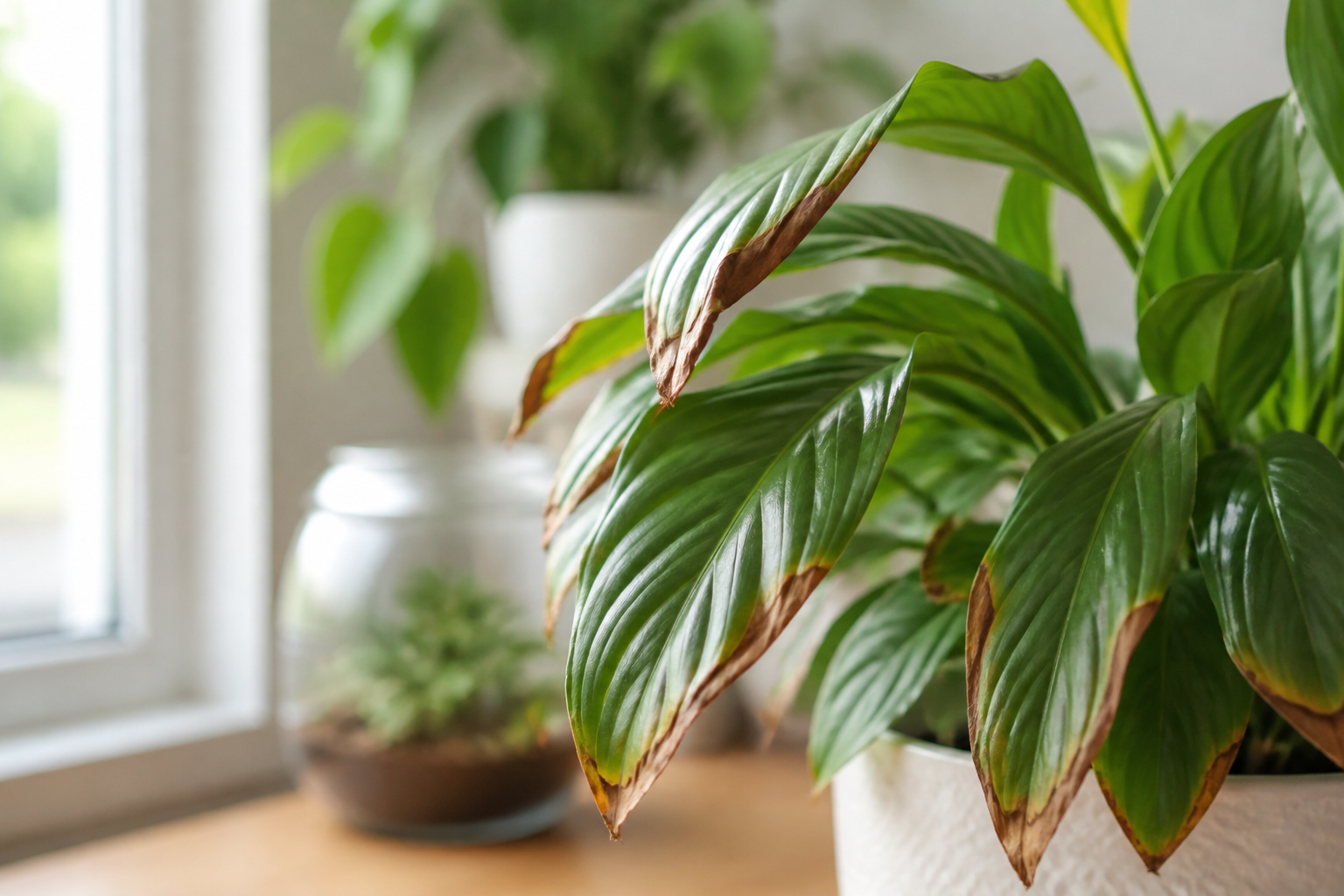
- Brown, crispy leaf tips and edges. See brown tips on houseplant leaves.
- Wilting despite adequate water
- Yellowing or dropping leaves
- Stunted growth, or new growth that looks distorted
If you see these, stop feeding, and flush the soil. Take the plant to a sink, and slowly run lukewarm water through the pot for several minutes, letting it drain freely. Wait a month or two before feeding again, at a lower strength.
Signs of underfeeding
- Pale, uniform yellowing of older leaves
- Slow or weak growth
- Smaller new leaves
Yellowing has many possible causes, including overwatering and low light, so check those before reaching for fertilizer. See why houseplant leaves turn yellow. Light matters too, since a plant cannot use nutrients well without it. See what bright indirect light means.
A simple routine
- Feed in spring and summer, every two to four weeks, at half the label strength.
- Pause in fall and winter, or feed very lightly if the plant is still growing.
- Flush the soil with water every few months to prevent salt buildup.
- Watch the plant, and adjust.
If you are unsure what your plant needs, our plant care service can help.
Frequently asked questions
How often should I fertilize houseplants?
During the growing season, roughly every two to four weeks with a diluted liquid fertilizer. Reduce or stop in fall and winter when growth slows.
Can I fertilize a plant that is struggling?
It is usually better not to. Fix the underlying problem, such as watering, light, or pests, first. Fertilizer will not rescue a plant with root problems.
Is more fertilizer better?
No. Too much causes salt buildup, brown tips, and root damage. It is safer to dilute and feed less often.
Do I need special fertilizer for each plant?
Usually not. A balanced houseplant fertilizer works for most foliage plants. Specialty types help with cacti, orchids, and some flowering plants.